
Conscious intention is a very powerful (though underutilized) resource available to us for boosting our productivity. A lot of us fall prey to the myriad distractions around us, draining our energy and leading to time wastage. But, distractions are not only in our external environment. They take birth within our own minds as well. Preoccupation and Daydreaming are two main diversions that emerge internally. Left to their own devices, these two can significantly hamper our productivity. However, if we can steer them effectively with the strength of our conscious intention, then they can be transformed from mere distractions to actual productivity boosters.
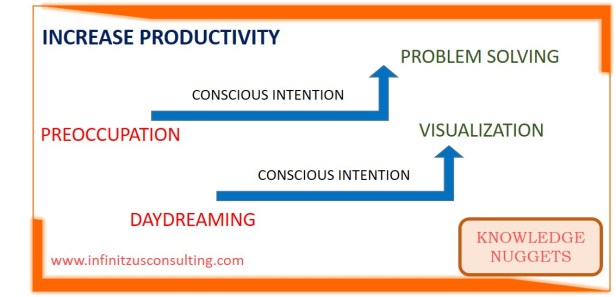 Preoccupation is like a buzzing background noise in your head. Obviously, with an irritating background noise, you cannot hear the voices of knowledge and wisdom coming from your Higher Mind, nor from around you.
How about having a little conversation with your preoccupation?
FROM PREOCCUPATION TO PROBLEM SOLVING
Preoccupation – “Hello, I need you to talk to me right now, its urgent”
You – “Miss Preoccupation, I must admit that you are very tempting, but right now it’s important for me to pay attention to the meeting I am attending. How about we schedule a date in the evening around 6? I am free that time, and I will be able to pay full attention to you”
If something is preoccupying you, then it matters to you. And, it needs some attention and energy towards its resolution. Instead of letting it remain a buzzing bee, which doesn’t let you focus on your present task, a better idea is to schedule an exclusive time on your calendar to focus on it. This way, using your conscious intention you would have achieved two objectives:
1 – Understood and executed priorities.
The current task that you are involved with needs your 100% presence, and you are making a conscious effort to devote all your attention and energy towards it
2 – Understood that the preoccupation needs to be resolved, and transformed it from a buzzing irritant to a problem solving exercise.
At the time that you have scheduled for it, look at the preoccupation as a problem solving exercise. Bring out all your problem solving tools and techniques to move towards a resolution.
It is quite possible that the resolution may turn out to be “Accept it, since you can’t change it”. And, if there is an emotional component to it, the preoccupation may continue to hover around. In such cases, it’s even more important to have the conversation you had earlier on with you preoccupation. Keep pulling yourself back into the present moment, trying to give it 100%. Sometimes you will succeed and sometimes you will not. But, you will surely feel better for having tried, and things will improve over some time.
The learning is that instead of letting the preoccupation dragging you away from what needs to be done, you use the force of conscious intention to transform it to a problem solving exercise. Then, the preoccupation doesn’t control you, rather you have consciously chosen to apply your mind to a problem solving exercise.
FROM DAYDREAMING TO VISUALIZATION
Daydreaming is a mixed basket. It has advantages like stimulating imagination and creativity, igniting intuition, leading to insights, and the most common one – acting as a stress buster. The disadvantage is when it impinges upon your mindspace, at a time when you need to give your 100% attention to a task in the present moment. That’s when it becomes a distraction. And, it is due to this that daydreaming is often seen as a sign of laziness and sloth.
Again, use the force of conscious intention and bring yourself back to the present moment. Schedule a time on your calendar for daydreaming. Oops! that sounds like you are scheduling a time slot to just goof off. So, lets give it a better name. Call it Visualization.
Schedule time for creative visualization and for restful visualization. With the force of conscious intention, you choose the time when you want to indulge in visualization. That’s the only thing you should consciously control – choose the best times that work for you – early morning with coffee, or afternoons after lunch, or at night if you are an owl. What you don’t want to control is the content of the visualization. That’s where the magic and mystery of the subconscious mind lies. You let the mind meander and flow wherever it wishes to go.
Schedule visualization breaks that help you rejuvenate. For example, after 90 minutes of intense work, schedule a 15 minutes visualization break. Let the mind flit and float like a bird or a butterfly in a beautiful garden, let it smell the roses and walk on the soft grass. Let it walk on a lovely beach watching the sunset, while the waves gently nibble at your toes. These are powerful stress busters, known as restful visualization, having similar relaxing effects on our biochemistry as if we were actually there.
Schedule time for creative visualization. Let the subconscious uncover ideas, insights, connections, and patterns. Let it iterate on a problem, looking for solutions. Let it visualize the achievement of a goal, and the joy of victory – strengthening your motivation towards achieving it. The time devoted to visualization is the time for reaping the rewards of divergent thinking.
We need both convergent and divergent thinking to boost our productivity. Convergent thinking is about laser sharp focus, it’s about single-pointed thinking, and about removing the unnecessary, so all energy and attention is concentrated on achieving the objective.
Divergent thinking is about “more and diverse” – more ideas, opinions, thoughts, diverse perspectives and suggestions. It’s about opening the floodgates of imagination, so you can look at an issue or a problem from all possible angles. Effective thinking requires the cyclical usage of divergent and convergent thinking, depending upon the situation. Daydreaming is nature’s way of bringing divergent thinking into our lives. Once you add a small dose of timing discipline to daydreaming, it gets converted to visualization, which has immense benefits for us.
Using conscious intention, we actually give the respect and importance due to both types of thinking, ensuring that we are in the right thinking mode at the right time. Lets do some self-reflection now :
- How will you use conscious intention to deal with preoccupation and daydreaming?
- How will you use conscious intention to bring in more effective convergent and divergent thinking?
 Gulshan Walia Blog