
Time and time wait for no one – Geoffrey Chaucer
To lose patience is to lose the battle – Mahatma Gandhi
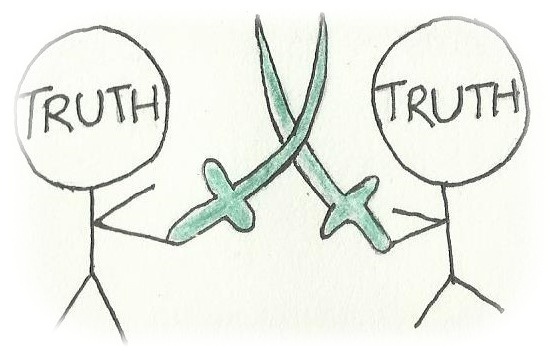
The above statements tell us that Speed and Patience, both are important. They seem at opposite ends of the spectrum, yet both are a truth. There are many such opposing truths in life, for e.g, speech and silence, work and relaxation, holding on and letting go. A person’s ability to stay true to both the opposing truths is a clear-cut mark of wisdom.
Like author F. Scott Fitzgerald said:
“The test of a first-rate intelligence is the ability to hold two opposing ideas in mind at the same time and still retain the ability to function.
This ability is also known as holding the tension between opposites, and it needs a well developed capacity for integrative thinking. A lot of problem solving teaches us about analysis – breaking down a problem into smaller parts, but we don’t learn much about synthesis as a problem solving technique. Synthesis involves building up or bringing together different parts to create a different or better whole. To the extent that we don’t use integrative thinking and synthesis as tools in our problem solving toolbox, we lose out on possibilities and options.
The gap between two truths should not be considered as a distance, rather it is to be considered as a spectrum or a range. You choose your position on this spectrum based on the demands of the situation, people involved in it, cost benefits etc. So it is a dynamic equilibrium as the position keeps changing for different situations, and even within the same situation. Visualise an adjustable / sliding scale, where you can move back and forth and choose your position based on a holistic understanding of the situation.
And then there is the possibility of finding a higher truth through creative resolution which takes you beyond the scale itself. The scale now transforms into a triangle opening up so many more possibilities. For e.g, holding on and letting go are two opposing truths. The triangle would look like this :
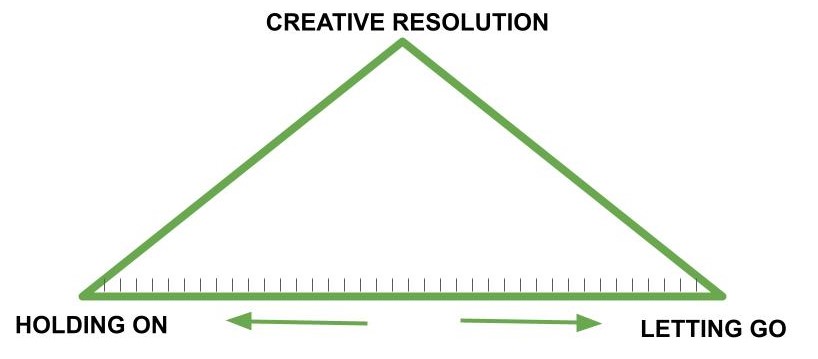
What comes in our way of being able to move back and forth, and upwards on this triangle?
Our own self, our personality, our biases, our prejudices and our worldviews. Depending upon our need for control, we will be naturally inclined to one side of the holding on – letting go spectrum. Our natural leaning towards speed or patience will reflect in our position on the speed-patience spectrum.
What enables us to easily move back and forth, and upwards on this triangle?
Integrative thinking is the answer! Integrative thinking needs the ability to look at situations from different perspectives as well as holistically. It needs great listening skills to understand the situation from people’s unique frames of reference. Curiosity, open-mindedness, flexibility, adaptability and creative problem solving are all essential to integrative thinking. Everytime you are faced with a situation which has opposing truths, think about the triangle, and decide what is the most appropriate position on it.
What happens if you go off the scale on to one side?
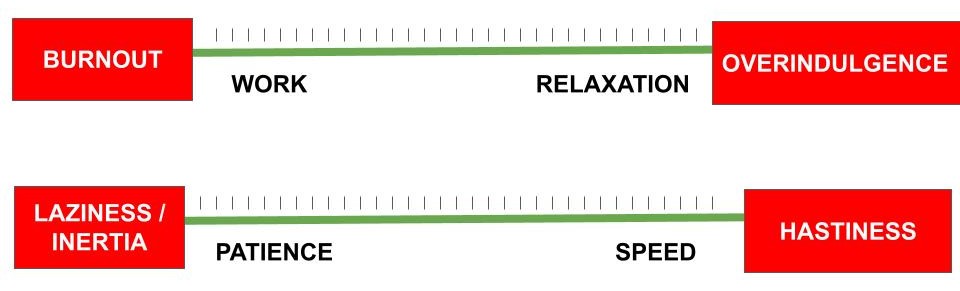
This is an interesting question because it brings in the paradox of an overused strength. If you overuse your strength of speed, it becomes hastiness. If you overuse patience, it could become inertia or laziness. Again, it is very easy to go off the scale unless you keep a check on it, or have people in your team who have the
opposing strength to help you take appropriate positions on the triangle.
Self Reflection
- What are the opposing truths / conflicting priorities that you have faced or are facing? Very often, we do not even realise the nature of the problem. We blame people and situations, but don’t understand that the problem was really about finding an appropriate position on the triangle.
- Do you tend to lean towards certain truths as part of your personality?
- Do you have any mechanism to help you stay true to both truths (introspection / people with the opposing strength / wise friends etc.)?
- Can you find a creative resolution to this problem? Or are there ways in which you can move back and forth on the spectrum and maintain a dynamic equilibrium?
Follow me on Linkedin for insightful content on self-development, leadership, anything and everything that makes us and our lives better. https://www.linkedin.com/in/gulshanwalia/
References
- The Opposable Mind: How Successful Leaders Win Through Integrative Thinking by Roger L Martin, Harvard Business School Press
- https://www.psychologytoday.com/us/blog/stronger-the-broken-places/201807/holding-the-tension-the-opposites
- https://www.psychologytoday.com/us/blog/behavior-briefing/202110/holding-two-thoughts-the-same-time-is-hard-and-important
- https://www.navigatethechaos.com/post/how-often-can-you-hold-two-opposing-ideas-in-your-mind-at-the-same-time#:~:text=In%20psychology%2C%20this%20holding%20of,someone%20off%2C%20you%20experience%20dissonance.
- https://www.gailgoldenconsulting.com/embracing-zozobra/
 Gulshan Walia Blog