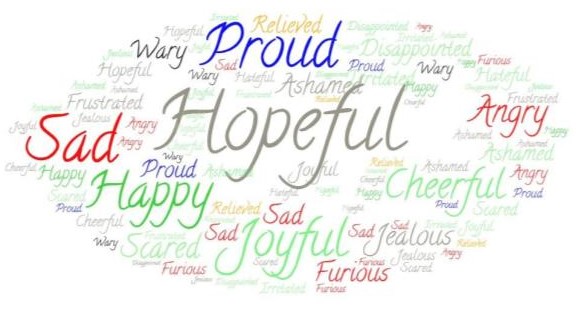
 Emotional self awareness means putting a finger on the exact emotion you are feeling.
There are times when you feel a jumble of emotions, much like a tangled mess of wires. You could feel joy and fear simultaneously, for e.g, joy at getting a great opportunity, and fear or anxiety about being able to perform. There are many such times when your emotions are in a complicated tangle.
The ability to untangle these emotions, identify the emotion accurately and the reason behind it is emotional self awareness.
You should be able to fill the blanks in the sentence “I am feeling <emotion> because <_________>.
Identifying and labelling emotions accurately gives a clearer picture of the problem statement. For e.g, you might be feeling sad. But the sadness could be because of feeling disappointed or ashamed.
The emotion of disappointment needs a different coping technique compared to feeling ashamed. When we are more specific in identifying our emotions, we are able to choose better, more fitting and aligned actions for managing them.
In the case of disappointed and ashamed, here is what the “I am feeling…” sentences could look like:
“I am feeling disappointed because Samir did not meet the deadline for submitting the proposal”
“I am feeling ashamed because I am not able to manage Samir and get him to submit his work on time”
If you felt disappointed, you may choose to have a conversation with Samir and explain the importance of deadlines to him. If you felt ashamed, you might work upon improving your leadership skills. If you felt both disappointment and shame, you would talk to Samir as well as improve your leadership skills.
If you use the word sad instead of disappointed and ashamed, you would lose the clarity of the exact emotion. This will hamper the actions you choose for resolving the emotions. Therefore it is important to have a good emotional vocabulary so you can identify your emotions well and work upon them.
Often under stress and conflict, we react impulsively even before we have had time to identify our emotions. Other times we are in denial with ourselves about our emotions.
We might refuse to accept that we are feeling jealous / angry / spiteful. We don’t want to accept that these difficult emotions exist within us, because they make us feel lesser or lower as a human being.
So, we lie to ourselves that we are confident and secure within ourselves, or the other person deserved the nasty response we gave. A better way is to accept that difficult emotions are also a part of being human, and they can arise in us. Only when we accept the emotion, can we start coping with it, learning from it and managing it.
Self Reflection
Think about the previous 6 months, and any significant incidents that happened during that time. Write down the “I am feeling________because________” statements for the emotions you experienced. What were the action steps you took to resolve it? How will you handle it if the similar emotion arises again?
Follow me on Linkedin for insightful content on self-development, leadership, anything and everything that makes us and our lives better. https://www.linkedin.com/in/gulshanwalia/
References
- The Emotionally Intelligent Workplace – How to Select For, Measure, and Improve Emotional Intelligence in Individuals, Groups, and Organizations by Cary Cherniss, Daniel Goleman · 2001
- Emotional Intelligence in Action by Marcia Hughes, L. Bonita Patterson and James Bradford Terrell
- https://positivepsychology.com/emotional-intelligence-frameworks/
 Gulshan Walia Blog